Skip to Main Content

Foodservice Industry Trends 2026: 5 Data-Driven Insights Shaping the Market Right Now

Food Trends, Foodservice, Innovation, Menu Trends, Restaurants, Sales Effectiveness

Stay informed on the latest food industry insights by subscribing to our newsletter.

Two-thirds (64%) of consumers say the world felt more unstable over the past year, a recent Datassential survey found, setting the backdrop for how both operators and consumers are approaching foodservice decisions in 2026.

According to Datassential’s latest sales intelligence data — spanning operator performance, consumer behavior, menu activity, and restaurant unit counts — the market is sending mixed but highly actionable signals. Growth hasn’t disappeared. Pressure hasn’t eased. Instead, the industry is recalibrating in real time.

In these uncertain times, it’s critical to have a partner that cuts through the noise. 

Here are five things foodservice professionals need to know about the state of the industry right now, based on what Datassential’s proprietary data and surveys are actually showing. And if you’d like to explore the insights shared by Datassential experts, watch our 2025 By the Numbers webinar on demand.

Restaurant Growth Is Still Happening, But It’s Uneven

On the surface, restaurant openings suggest momentum. Dig deeper, and the story becomes more nuanced.

According to Datassential’s January Table Stakes Tracker:

Roughly 2,400 new restaurants opened in the most recent month, compared with 1,250 permanent closures

Independent operators account for the majority of both openings and closures, signaling opportunity paired with volatility

The U.S. now has nearly 859,000 active restaurants, a historically high count despite ongoing cost pressure

3 in 4 Operators Are Profitable (And Cautiously Optimistic)

Operator sentiment heading into 2026 reflects resilience, not complacency, and that mindset mirrors broader uncertainty across the economy.

A Datassential January operator survey found that:

About three-quarters of operators describe their most recent month as profitable or better

Roughly 75% expect sales and traffic to either increase or stay the same in the coming month

At the same time, food costs (over 70%) and labor costs (mid-50%) remain the top operational challenges

75% of Consumers Are Just Getting By or Falling Behind Financially

Inflation and cost of living remain top concerns for consumers in 2026. But that hasn’t eliminated demand for food away from home.

According to a Datassential January consumer survey:

Dining-out expectations are split: 17% plan to dine out more often, 43% expect no change, and 36% plan to cut back

A majority of meals are still prepared at home, but a meaningful share continues to be purchased away from home

More than seven in ten consumers skipped at least one traditional meal in the past month

Snacking, late-night eating, and nontraditional dayparts continue to rise

72% of Consumers Became More Selective About Food Spending

Menu and sales tracking provides one of the clearest windows into operator decision-making.

That caution is reinforced by Datassential’s broader consumer findings, which show that 72% of consumers became more selective about where they spend money on food, raising the stakes for every menu and pricing decision operators make.

What’s Performing on Restaurant Menus Right Now

Datassential found:

  • Lunch and dinner remain the most widely offered and stable dayparts
  • Snacking occasions are increasingly influential, even when they aren’t formal menu categories
  • Entrées, handhelds, and sides show relative sales stability
  • Beverages and desserts are more vulnerable to trade-down and stagnation
  • Limited-time offers are favored over broad menu expansion

In 2026, innovation isn’t disappearing — it’s becoming more targeted. Operators are experimenting where risk is contained and protecting the items that anchor traffic and check averages.

The Biggest Risk Isn’t Volatility — It’s Misreading the Market

Taken together, Datassential’s sales intelligence shows an industry that is neither booming nor breaking.

Instead, foodservice in 2026 is defined by:

Fragmented growth

Selective consumer spending

Operator caution paired with resilience

Menus that balance consistency
with controlled innovation

The Bottom Line: Foodservice Industry Outlook 2026

Foodservice professionals don’t need more noise—they need clarity.

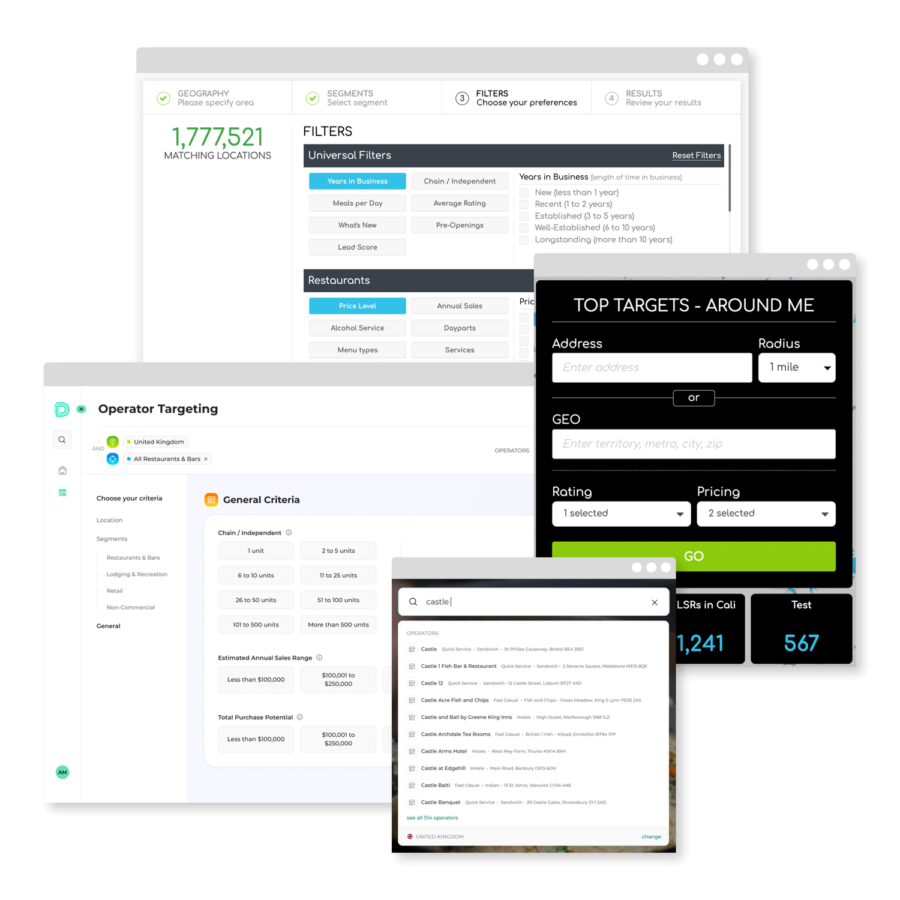
Datassential Sales Intelligence helps illuminate what’s actually happening across the industry right now, so teams can make decisions rooted in reality, not assumptions.

Because in 2026, understanding one piece of the market isn’t enough.

You need the full picture.

Explore how Datassential Sales Intelligence connects these signals in one place — across operators, consumers, menus, and the restaurant landscape — to support smarter, more confident decisions.

FAQ: Foodservice Industry 2026

  • How many restaurants are operating in the US in 2026?

    Nearly 859,000 active restaurants, with approximately 2,400 new openings and 1,250 closures monthly.

  • What percentage of restaurant operators are profitable in 2026?

    About 75% of operators report their most recent month as profitable or better, with a similar percentage expecting sales and traffic to increase or stay the same.

  • How are consumer dining habits changing in 2026?

    Over 70% of consumers skipped at least one traditional meal last month, with snacking and nontraditional eating occasions on the rise. Additionally, 75% of consumers say they are just getting by or falling behind financially.

  • Which menu categories are most stable in 2026?

    Entrées, handhelds, and sides show relative stability, while beverages and desserts face greater trade-down pressure.

  • What are the top operational challenges for restaurant operators in 2026?

    Over 70% of operators cite food costs as a top challenge, while mid-50% identify labor costs as a primary concern.

  • Why are consumers more selective about foodservice spending in 2026?

    72% of consumers became more selective about where they spend money on food, driven by financial pressures and a perception of increased world instability (64% of consumers).