 EN | English UK
 DE | Deutsch
 ES | Español
 FR | Français
 IT | Italiano
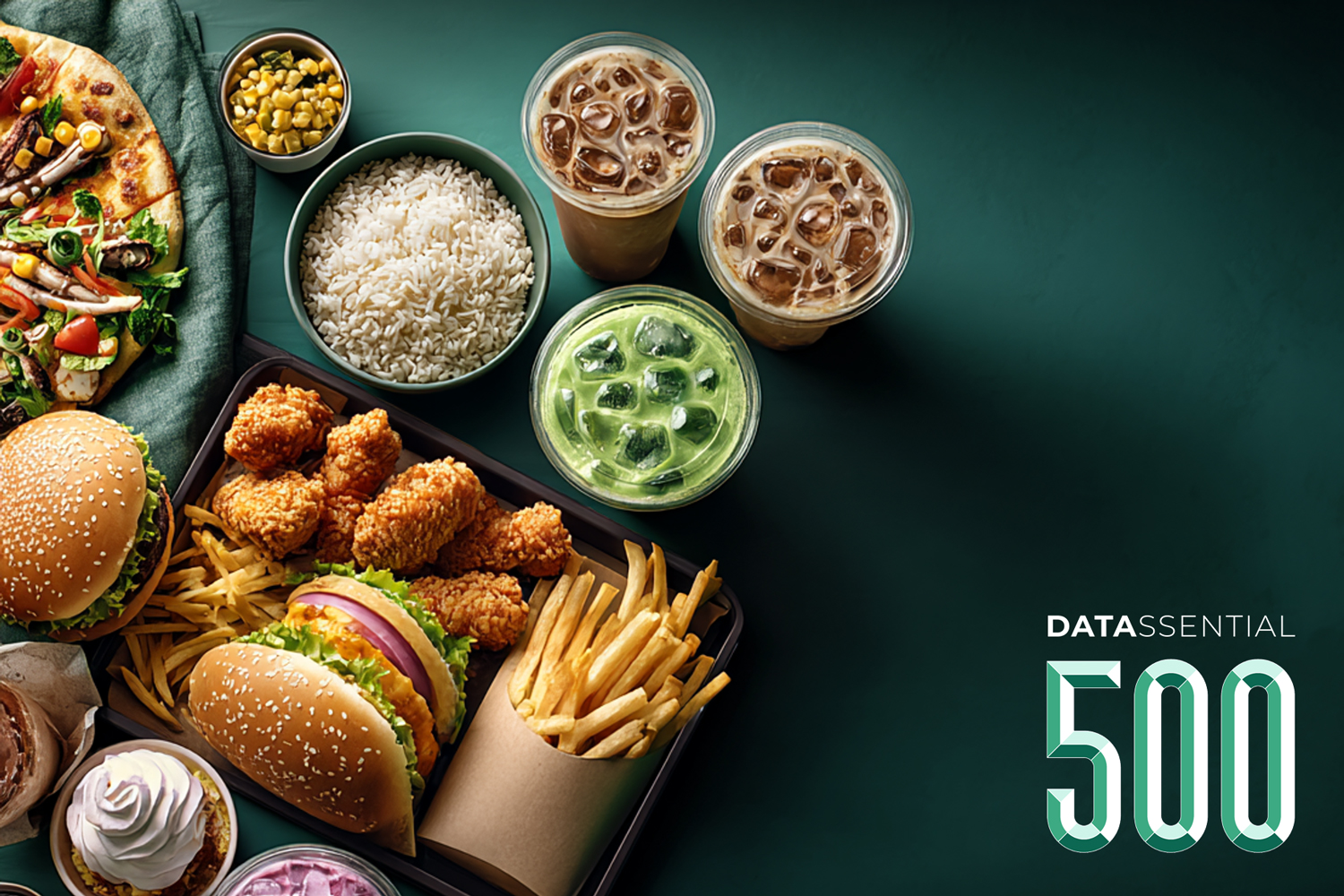
Every year, Datassential releases the Datassential 500 report, ranking the top restaurant chains in the United States by analyzing metrics such as unit count and sales, benchmarking consumer perception, and spotlighting the brands growing fastest across 16 segments, as well as emerging new contenders. But the real value isn’t just knowing who topped the charts. It’s understanding the structural shifts underneath, the segments quietly rewriting the competitive landscape, and the consumer trends reshaping demand.
This year’s Datassential 500 offers a clear signal: the restaurant industry is growing, but not evenly. Knowing which segments are gaining traction could be the difference between building on momentum and being left behind. Here’s what the data is telling us.
The Big Picture: $447 Billion and a Market Still Moving Forward
The 500 largest restaurant chains in the U.S. now represent 244,000+ units and $446.13 billion in total sales — up 2.6% since Q4 2024. Average unit volume (AUV) climbed 2.6% to $1.82 million, a sign that the chains managing to grow units are also managing to grow sales at those units.
For operators and suppliers looking at food industry insights heading into the back half of 2026, this is a market that is expanding but increasingly divided. The segments winning on unit count aren’t always the ones winning on sales, and the ones winning on sales aren’t always winning on consumer love. The full picture requires a comprehensive look into all three.
QSR Dominance & the Growth of Fast Casual
Quick service restaurants (QSRs) still dominate the Datassential 500 footprint by a wide margin — 175,000+ units generating $286 billion in sales. Nothing else is close. But the story of 2025 and early 2026 is less about QSR’s dominance and more about fast casual’s ascent.
Fast casual now accounts for 44,000+ units and $80 billion in sales, with an AUV of $1.6 million — meaningfully higher than QSR’s $1.2 million per unit. That gap in productivity matters to anyone building or selling into a fast casual concept. Meanwhile, casual dining sits at 11,000+ units and $49 billion in sales with an AUV of $3.4 million, reminding us that full-service restaurants still command significant check sizes when consumers do choose to sit down.
The consumer data makes it clear why the QSR-vs.-fast-casual dynamic is so charged right now. 70% of consumers visited a fast food location in the past month, and 53% visited a fast casual location — but among QSR visitors, 55% reported that prices seemed higher than the last time they visited. That perception gap matters, and it’s creating space for fast casual to position itself on quality and value simultaneously.
The Chicken Takeover Has Arrived
If there is one category-level trend in the Datassential 500 that demands attention, it’s chicken. Limited service restaurant (LSR) chicken led all segments in unit growth at +4.4% and ranked fifth in sales growth at +4.2%. Those numbers reflect years of sustained consumer preferences accumulating into structural expansion.
The consumer perception data reinforces the picture. Chick-fil-A ranks among the top three chains for food quality, with 72% of consumers rating it “best in class” or “above average.” In a category where consumer trust is essentially the moat, that kind of brand equity is hard to overstate.
The chicken segment’s rise doesn’t exist in isolation. It sits at the center of one of the defining megatrends in the 2026 Datassential 500: protein taking center plate. Protein has shifted from a niche fitness cue to the main selling point for a wide swath of menu launches. Top chains released 81 protein-focused menu launches in 2025 alone. Coffee chains added protein to drinks. Sandwich chains introduced “Protein Pockets.” Fast casual brands marketed bowls with 80, 90, or even 100+ grams of protein. And 66% of consumers now say they’re interested in foods and beverages that are high in protein. Chicken-focused chains are winning because they sit at the intersection of health, indulgence, and value — and protein is the one menu signifier that delivers on all three simultaneously.
The Global Flavor Shift Is Now Mainstream
One of the most compelling consumer trends in the Datassential 500 is the acceleration of global and regional cuisine formats. Full-service restaurant (FSR) Regional/Global led all segments in sales growth at +5.7% and ranked second in unit growth at +3.5%. On the LSR side, Regional/Global posted +2.0% unit growth and +4.7% sales growth — both above the overall industry average.
The chains driving this aren’t niche experiments anymore. KPOT Korean BBQ and Hot Pot (128 units), Kyuramen (47 units), and The Halal Shack (46 units) are among the fastest growing chains in the U.S., putting more global formats into the growth pipeline.
The Snacking Economy:
Coffee, Bakery, & Dessert Are All Winning
Three adjacent categories are quietly putting up some of the strongest numbers in the entire Datassential 500.
LSR Bakery/Café grew units by 2.1% and sales by an impressive 5.0%. LSR Coffee grew units by 2.3% and sales by 4.9%. LSR Dessert/Snack grew units by 0.8% and sales by 3.2%. Paris Baguette, with 269 locations, ranked among the fastest growing chains in the LSR Bakery/Café segment. Founded in South Korea and built around Asian-inspired pastries, breads, and café beverages, it represents a format that sits well outside the American coffeehouse archetype — and its rapid U.S. expansion is a concrete signal of how global influences are reshaping even the most familiar dayparts.
What’s driving this? The consumer data offers a clear answer: 88% of consumers snacked outside of traditional mealtimes in the past month, and 76% used a snack to replace a standard meal at least once. The three-daypart model is giving way to a continuous eating occasion mindset, and the segments structured around that reality are thriving. Coffee shops, bakeries, and dessert formats are capturing the demand that traditional meal occasions are leaving on the table.
Value Isn’t a Trend — It’s the Condition
In 2025, the top chains in the Datassential 500 released 223 combo or value limited-time offers (LTOs) and menu launches. But the more telling number is what’s already happened in 2026: top chains have released 92 combo or value LTOs in just the first four months of the year. At that pace, 2026 is on track to exceed 2025 levels. What’s shifted isn’t just the volume; it’s the strategy behind it. The industry’s biggest brands have moved away from one-off promotional stunts and toward embedding value into permanent menu architecture. Tiered pricing platforms, recurring bundle deals, and loyalty-anchored offers are replacing the headline-grabbing discount tactics that defined the early value wars. Value is no longer a campaign. It’s becoming the foundation of how top chains are structured.
The pressure is just as real on the operator side. 72% of operators cited food costs as a top operational challenge, with labor costs close behind at 58%. The squeeze affects both ends: consumers want more value, and operators have less room to give it. The chains navigating this most effectively are those where value perception is baked into the brand identity itself. Little Caesars and Cici’s Pizza both ranked at the top of the Datassential 500’s Value for the Dollar category, with 67% of consumers rating each ‘best in class’ or ‘above average’ — a reminder that the clearest value signals come from chains that have built affordability into their core proposition rather than layering it on through promotions.
That is a lesson applicable far beyond the pizza segment.
What This Means for You
The Datassential 500 isn’t just a leaderboard. It’s a real-time map of where capital is flowing, where consumers are spending, and where the white space is forming for the next generation of concepts. The food industry insights embedded in this year’s report — the protein megatrend powering chicken’s rise, the sustained mainstreaming of global flavors, the ongoing evolution of the value war, and the next era of fast casual — reflect consumer trends that have been building for years and are now showing up in unit counts and sales figures.
The brands and operators who win from here are the ones who see the pattern before it becomes consensus.
Download a free preview of the 2026 Datasential 500 report today.
Want to learn more? Explore Datassential’s intelligence platform.